

During the Steam Summer Sale this year, after having it recommended to me by a good friend, I picked up Loop Hero! An older roguelite that I had heard some about, mainly that it was good, but never tried it for myself. Along with horror, roguelites, or rogue likes, are one of my favorite genres! Even with multiplayer games with lots to grind for and technically endless replayability, roguelites will always be the genre of games I put the most time into. A good roguelite is one you can play for ages without getting bored by offering up loads of random elements and customization. That is usually the foundation of a good roguelite and what makes them so replayable. In a lot of other genres, random elements can be annoying but for roguelites, they are a part of the appeal. And Loop Hero not only has plenty of that but it also has a deceptively simple nature that makes it extremely easy to get into while it manages to be one of the more unique roguelites despite that.
On the surface, Loop Hero truly is a simple game. It’s a game about quite literally walking in a circle. While each map you are put in is random, they will always be a loop with your starting point being a camp.
The game basically plays itself for the most part as well. Your Hero walks the path on his own and fights on his own whenever he runs into something on the road that tries to stop him in his path. At the start of a run, that will just be basic and classic slimes. As you defeat these slimes though is where the game truly begins and you, the player, are given some input!
There are two kinds of rewards you get for winning a fight, equipment that you can place on the Hero to buff him in various ways and cards that can be placed on the map you are constantly walking on.
Equipment, like everything in Loop Hero, starts out pretty simple! You’ll be given things like a sword that can improve your damage, armor to improve your health, and a shield that can improve your defense. At first, that’s all they will do, but as the loops increase and stronger enemies appear, equipment will start having more effects. Things like being able to damage all enemies with your attacks rather than going one at a time or giving you a chance to evade or counter an attack rather than just giving you more defense to take hits. This is when you can start to build your Hero around the kind of play style you want! Given that all of the battles are played without your input, this is the only way you can really impact a fight. You might not be able to tell your Hero when to attack or block, but by building him in a certain way, you can control what he does and how he reacts. This is just the tip of the ice berg when it comes to how your Hero fights though! But we’ll get into that a bit later, for now let’s talk about those cards you can earn.
When you first start out on your adventure, the loop your Hero walks in will be barren besides that starting camp. He will just be walking in a blank circle with only slimes around for company, but this will quickly start to change. Like I said, along with earning equipment, you will also earn cards for defeating enemies. These cards are used to customize that blank path and populate it. On your first run, you will be given a deck to use, but as you complete runs and earn more cards you are free to customize your deck as you see fit! And this is really where your runs can differ from each other.
While you can pick what cards are in your deck, you can’t pick which cards you draw, that element is completely random, though some cards are more rare than others and are less likely to be pulled. Let’s talk about some of those cards in your starter deck though and how you actually use them to shape your run!
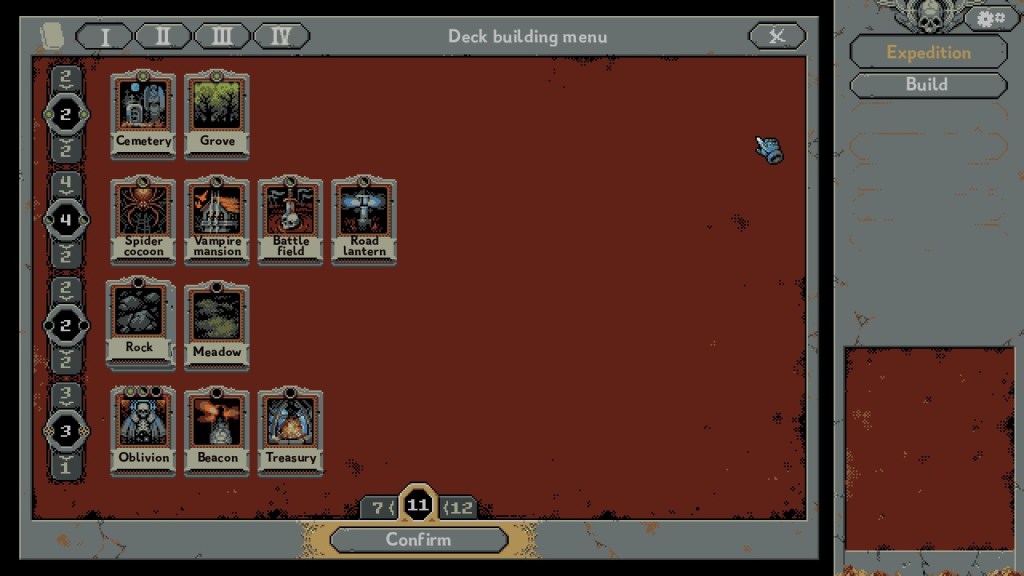
Even with just the starting deck, you’ll have quite a few cards available to you! Beyond differing by what they do, cards differ in how you can place them around the loop as well. Some cards can be placed right on the road, others can only be placed around the road, and others can be placed far away from the loop in the blank places around it! Lets look at the start of a loop to give a better frame of mind around how things will start off.
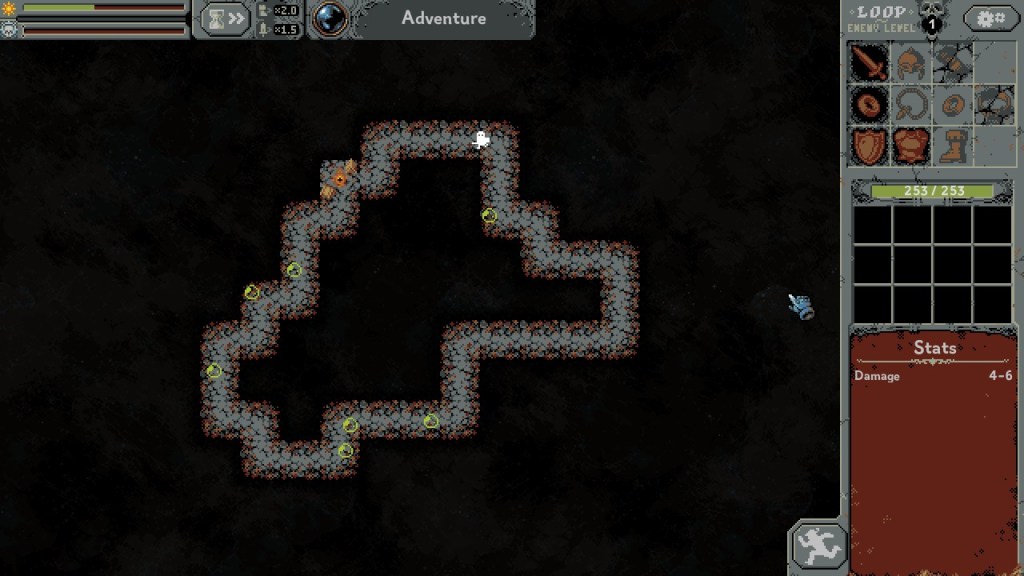
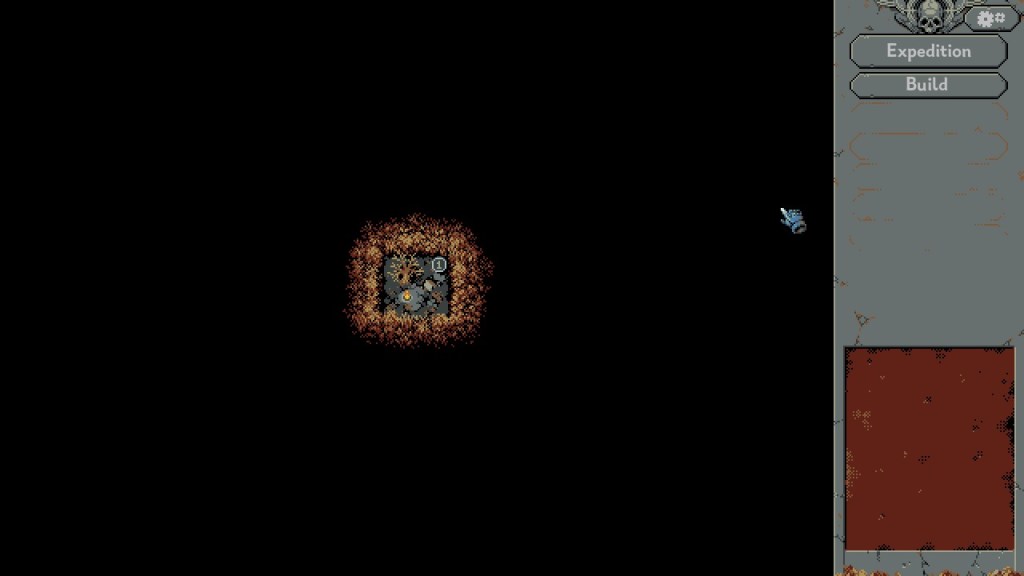
At the start of a run you’ll be given an empty looking loop like this. Like I said before, you can get cards by defeating slimes as the Hero walks in the loop. Once you do get some, it’s up to you on how you want to place them! Each card has its own effect and sometimes their placement can play into that. For example, the Beacon card can be placed just about anywhere besides directly on the road and directly next to it but it’s also important to keep in mind that this card has a radius of effect as well. Meaning you could put it in the corner of the map but it wouldn’t do anything, it’s far better to put it around the loop itself so that its radius can reach parts of the loop! The Beacon has a passive effect that makes the Hero move faster over the tiles that are in its radius while also making whatever is in its radius attack faster. Similarly, the Rock and Meadow cards can also be placed anywhere besides on top of or directly around the loop itself but different from the Beacon they don’t have a radius that needs to be kept in mind and simply provide passive buffs to the Hero regardless of where they are placed. Meaning you can fill out the background with cards like these rather than clutter up the area around the loop leaving that space open for cards that need to be placed around there.
Speaking of cards that need to be placed around the loop, lets talk about those! While cards like the Rock and Meadow provide buffs to the Hero, other cards aren’t so directly helpful. For example, there is the Vampire Mansion card. Placing this directly against the loop, which is the only place it can be, has vampires spawn in any battle that takes place around the mansion. It should be noted that vampires are enemies that you will have to fight! Meaning that by placing the Vampire Mansion, you are technically making things harder for yourself by causing stronger enemies to spawn in. But in reality, this is actually a good thing! As you could probably guess, slimes are pretty weak enemies and really do not provide you much when it comes to equipment the Hero loots from defeating one. If you want stronger equipment and more cards from defeating an enemy, you need to fight stronger enemies! Such as the vampires. This is one of the most interesting aspects of the game to me!
As the Hero ventures around the loop, it is your job to make the loop more difficult while also providing buffs to the Hero to make sure he can actually make it through! It’s a balance of not making things so hard that the Hero dies but also making sure things aren’t so easy that he can be strong enough to take on the boss of the loop, something we will get to later. Like I said, cards can buff the Hero in certain ways while also providing new enemies to fight as well. This is very much the case for the cards that you place directly on to the loop itself!
The cards in your starter deck that can be placed directly on the loop only provide areas for monsters to spawn but that will change eventually. These cards are the Cemetery, which spawns skeletons, and the Grove, which spawns wild dogs. Rather than adding enemies to existing fights, these cards change tiles on the loop to simply have new enemies while ensuring enemies like the slimes can no longer spawn there. And since these cards are placed right on to the loop itself, it means that you can also place a Vampire Mansion near them too if you really wanted to make things that much tougher by adding vampires to these fights as well! Later on you will unlock cards that can be placed right on the loop without inviting new enemies in, like the Village card that spawns in a village that will heal the Hero and give him quests. However, place too many of those and you’ll start getting bandits in your villages! Or place a village too close to a Vampire Mansion and suddenly the villagers will be at the vampire’s command! I won’t go into too much depth on this aspect of the game, mainly because it would take ages to go over each combination, but I did want to touch on the fact that cards can have different effects depending on how many there are and what other cards are around it. Another example can be found with the Rocks. Place enough Rocks around each other and suddenly you get a Mountain Peak! And keep placing Rock cards and you’ll notice goblins beginning to spawn around the loop. Discovering these things is one of the most fun parts of Loop Hero so I won’t rob you of that by explaining further.
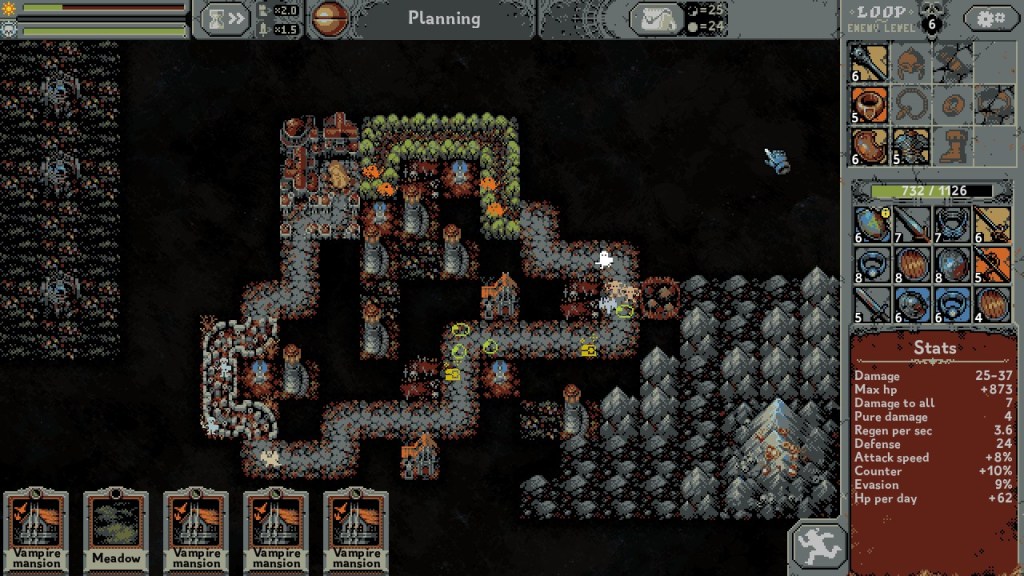
There is one last kind of card though, these cards are usually special in some way that really makes them stand out in terms of what they can do and where they are placed. The best example of this is probably the Oblivion card. Rather than making a tile, the Oblivion card deletes a tile! This can be good for if you accidentally placed a card somewhere you didn’t mean to or for getting rid of a tile that spawned from placing other cards that you don’t want, like those bandit camps that appear after you play enough Village cards. If you see a card in this category it’s always good to read up on what it does before you add it to your deck or place it. While they can be straight forward like the Oblivion card, they can also be more complex about how to make them actually useful.
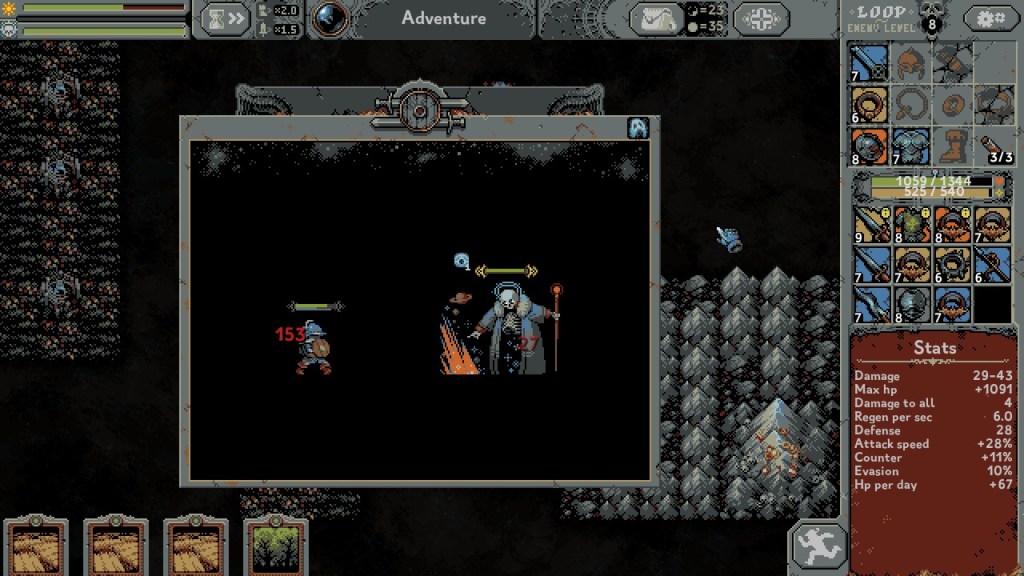
Now after all this, you might be wondering what exactly the point of it all is. Despite the fact that roguelites are meant to be played endlessly, there usually is an end point to each individual run. And there is here in Loop Hero as well! As you place cards around, a meter in the top left of the screen will start to fill up. When it does finally fill completely, a boss will spawn in place of your camp! Beating this boss is the goal of the loop and why you’ve been building your Hero up. Getting strong enough to beat the boss isn’t the only thing you can be building up for though. As you pass through tiles and beat enemies you are also collecting supplies and materials. These things can be used to build your base camp between runs! And this is how you’ll start to build your Hero up beyond just getting equipment for him while doing your runs.
Like a lot of roguelites, you can unlock new abilities and systems to help with your runs between said runs! How you go about this in Loop Hero is by building up your base camp. Between runs you will return to your camp where a group of survivors have also gathered. By gathering supplies and materials while doing a run, you can start to build different buildings and such that will unlock new aspects of the game. For example, by building the Herbalist’s Hut you unlock potions that the Hero can drink during a run to regain health. There is also the Gymnasium that unlocks the ability to level up and earn skills while out on a run as well! Not only can these buildings unlock new gameplay features like that they are also how you get new cards to build your deck with. For example, by building a forest around your camp, you unlock the Forest card!
The camp is really how you start to expand the game play and bring more variety to the game as a whole, you are even able to unlock new classes for the Hero that changes things drastically! Meaning the camp is something you should really not ignore as it helps turn this simple game into anything but that, which is a good thing!
Loop Hero is truly deceptively simple at times. If you really break it down, it’s a game about walking in a circle over and over again where you don’t even really control the character walking that circle. But with the card system and how it is up to you on how you build out this loop, it adds so much depth that I would have never expected and in a way that is completely different from so many other roguelites. Usually in other games, the challenge of a run doesn’t come from the players input like it does in Loop Hero. But at the same time, you have so many reasons to not make it easy on the Hero running the loop. The risk and reward element of the game adds so much and it is truly fun to watch as a loop comes together and gets filled out by all the things you put around it, bringing this boring circle to life in the process. Which actually ties into the game’s story remarkably well!
I haven’t really touched on it at all up until now, but Loop Hero very much has a story to it! Basically, the world and universe as we know it ceases to be. But not in a usual way. There’s no explosion that wipes everyone out and destroys everything, things simply just cease to be like they are being erased. And when I say things I don’t just mean people and cities, I mean memory as a whole and concepts in general! When starting the game, the Hero himself doesn’t even truly know why he is going in this loop, he just knows something is wrong and he wants to fix it. He also seems to be one of the very few to actually remember things how they were. This is why loops always start out so blank with nothing on or around them. There truly is just nothing out there. But by remembering things, the Hero is able to build up a path and start to piece things together again. As you probably guessed, these memories come in the form of the cards! By placing them down, you are basically having the Hero remember these things which helps bring them back in this world. And because this is all based on memory, and not all memories are good, you get things like the monsters that attack the Hero! The Hero will often times even comment on these things. Like when bandits start appearing in towns again, the Hero comments that he isn’t sure if he should be upset or not that bandits have returned. On one hand they terrorize him and villages, but on the other hand the fact they exist at all does mean things are started to get back to normal! It’s very rare to see a game that has its game play and story work so seamlessly together. I won’t go further into detail on the story though and let you discover the rest on your own.
Like I said before, it’s impressive how simple things start with Loop Hero. The game is literally about watching a character walk in a circle. But the game ends up having so much depth and replayability! Like any good roguelite. So if you are a fan of the genre, this is a very easy recommendation! It’s available on PC, Switch, Xbox, and mobile phones making it pretty easy to pick up and play.
But those are just my thoughts! What are some of yours? Does Loop Hero sound interesting to you? Do you like any other roguelite games? I’d love to hear your thoughts so don’t be shy!
And thank you for taking the time to read the post! If you enjoyed it feel free to leave a Like or share the blog with a friend. You can also follow the blog on WordPress or on Twitter if you want to stay up to date on new posts. Also if there’s a topic you’d like me to discuss sometime, go ahead and tell me in the comments! Any interaction is appreciated, even just viewing this post, so thanks again for stopping by.


Leave a Reply